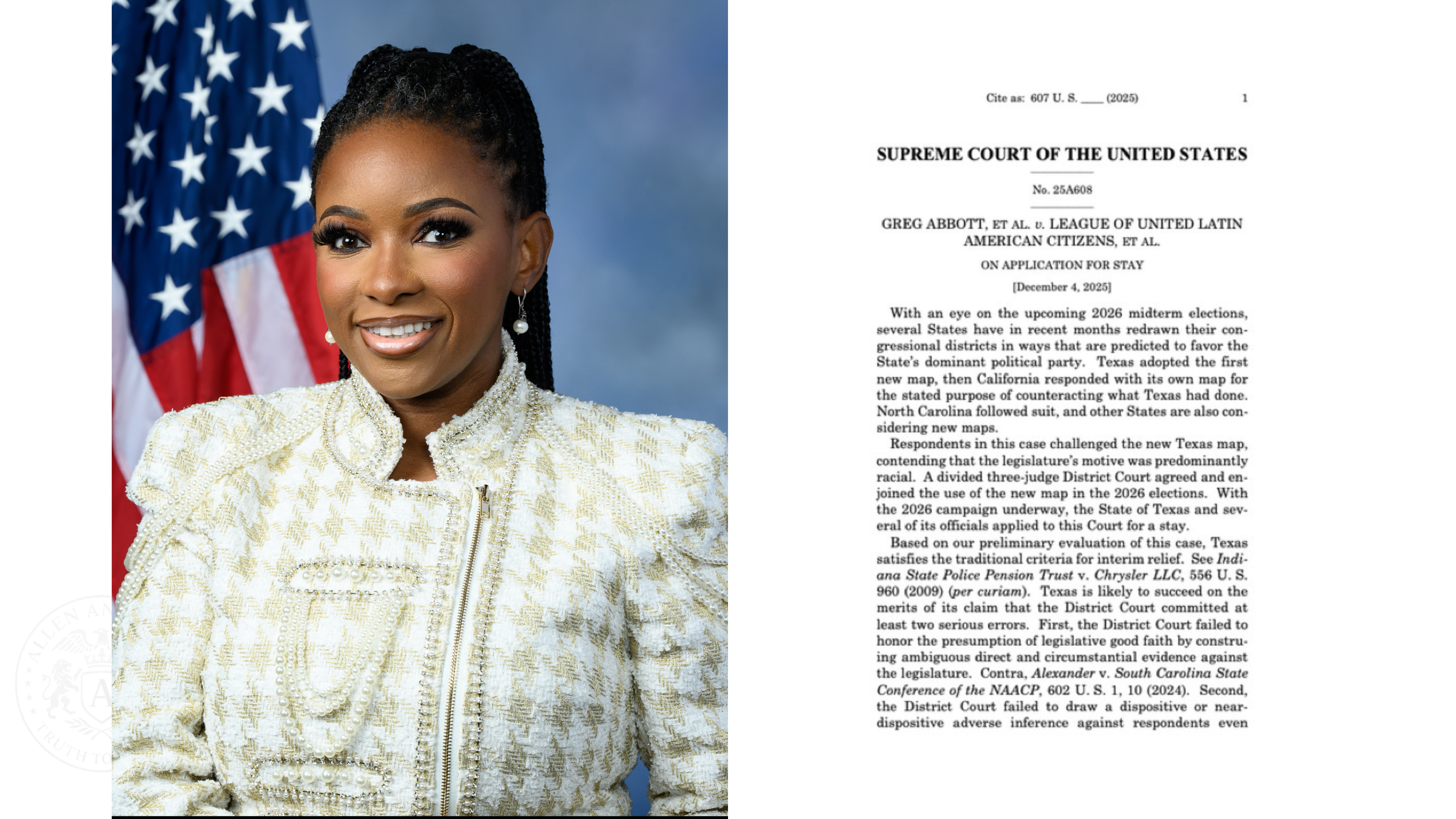
Jasmine Crockett Didn’t Lose a Race. The Supreme Court Moved the District.
Texas’ new congressional map pushes a sitting Black progressive out of her own seat and locks in one of the most extreme gerrymanders in the country. What just happened in Dallas is not a local story.
When voters in Dallas sent Jasmine Crockett to Congress, they did not just elect a Democrat.
They elected a loud, unapologetic Black woman who calls out corruption on live television, drags MAGA witnesses in committee hearings, and says the quiet part loud enough to rattle the chandelier.
Republican lawmakers in Austin watched that happen in a district where Donald Trump underperformed. They did not respond by trying to win the next election. They responded by moving the lines.
And now the Supreme Court has signed off.
On December 4, the Court quietly granted Texas’s request for a stay in Greg Abbott v. League of United Latin American Citizens, allowing the state to use its new congressional map in the 2026 elections while litigation continues. The order notes that multiple states have recently redrawn maps to favor their dominant party and specifically describes Texas’ new plan as one adopted “with an eye on the upcoming 2026 midterm elections.”
Translation: the justices know this is partisan hardball. They approved it anyway.
How Jasmine Crockett’s District Was Carved Up
Under the old map, Crockett represented a safely Democratic, heavily Black and Latino district anchored in southern Dallas. That district was one of the few in Texas where voters of color could reliably elect a candidate of their choice.
The new map rips that apart.
Reporting from Dallas outlets describes how her home is drawn out of her current district and dropped into a new, whiter, more Republican-leaning one that stretches further into the suburbs. The remaining Democratic district in Dallas is packed even more tightly with voters of color, while surrounding seats are engineered to be safely Republican.
The result is classic surgical gerrymandering:
“Democrats currently hold only 13 of 38 seats (34 percent) despite getting between 46 and 48 percent of the vote in recent statewide federal elections.”
Texas did not “accidentally” misalign seats with votes. The Brennan Center describes the map as one of the most skewed in the country, noting that 21 of the 25 Republican-held districts are places Trump carried by at least 15 points in 2020.
Those are not competitive districts.
They are political bunkers.
For Crockett, the message is simple. If she stays put, she will be running in a new district specifically constructed to dilute the base that elected her. To protect her political future, she may have to move, challenge a fellow Democrat, or gamble against impossible math.
This is not “the voters chose someone else.”
This is the map choosing for them,
What the Supreme Court Just Did
A three-judge federal district court previously found that Texas’s mid-decade redraw likely violated federal law and blocked the map from taking effect.
The Supreme Court stepped in and overruled that pause.
In its unsigned order, the Court criticized the lower court for failing to show sufficient “deference” to the legislature’s decisions and suggested that Texas is likely to prevail on the merits. The opinion acknowledges that several states have redrawn maps in ways “predicted to favor the State’s dominant political party,” but still concludes that Texas met the standard for emergency relief.
The consequences are concrete:
Republicans already hold 25 of Texas’ 38 congressional seats.
Under the new map, partisan analysts estimate that the GOP could net up to five additional safe seats, pushing the delegation toward a 30 to 8 split in a state where Democrats routinely win close to half the statewide vote.
Those numbers are not a typographical error.
They are evidence.
Texas is on track to send an overwhelmingly Republican delegation to Washington while nearly half its voters choose Democrats.
And Jasmine Crockett’s situation is the most visible human example of what that looks like in practice.
From One District To A National Pattern
What is happening to Crockett is part of a much larger design.
The Brennan Center’s national analysis of the 2020s maps concludes that partisan gerrymandering gives Republicans a significant structural edge in the battle for the House. Texas and Florida alone account for ten additional safe GOP seats compared with a fair, Voting Rights Act compliant baseline.
In Texas:
A map with proportional representation would likely have 18 Democratic leaning districts, closer to Democrats’ actual vote share. Instead, they have 13.
In Florida, Republicans transformed a 16–11 split into a 20–8 advantage by dismantling a Black represented seat and redrawing multiple urban districts.
North Carolina’s newest map may cut the number of Democratic congressional seats in half, from six to three, despite the state’s near even partisan divide.
Ohio, Tennessee, Georgia, Indiana, South Carolina, and Utah all used the 2020 cycle to turn once competitive districts into safe Republican territory.
None of these maps were designed to reflect the electorate.
They were designed to insulate power from it.
Jasmine Crockett’s district is simply where the data becomes personal. A loud Black freshman who embarrassed Republicans on television is being pushed off the board not by voters but by cartography.
What Gavin Newsom And California Are Doing In Response
Republicans in Texas framed their new map as a legitimate expression of state power. But the Supreme Court’s order itself quietly acknowledges that other states are now responding in kind.
The opinion references how California “responded with its own map” aimed at counteracting Texas’ move, with North Carolina and other states considering similar measures.
That is where Gavin Newsom enters the story.
California currently uses an independent Citizens Redistricting Commission. Political scientists at the Public Policy Institute of California note that commission drawn maps produce seat shares that closely track the statewide vote, rather than dramatically over rewarding one party.
But anger over Texas, Florida, and North Carolina has created pressure on California Democrats to abandon the high road. A proposed constitutional amendment known as Proposition 50 would allow mid decade redistricting and explicitly argues that California should not “unilaterally disarm” while Republican states carve out fortress maps.
Supporters of Prop 50 say openly what Republicans in Texas hinted at. They want to draw a map that picks up additional safe Democratic seats in order to offset GOP gerrymanders elsewhere.
This is the spiral the Supreme Court has unleashed.
If the Court blesses extreme partisanship in Texas, California is under growing pressure to answer not with reform but with revenge.
Gerrymandering By The Numbers
For people who do not live inside the world of precinct maps and line drawing, this can sound abstract. So here is what the data looks like when you put it in a spreadsheet.
The Brennan Center calculates that Democrats win between 46 and 48 percent of the vote in recent Texas statewide federal elections. Yet they hold only 34 percent of the congressional seats. At the same time, 21 of the 25 Republican held districts are so heavily pro Trump that they are functionally off the table for competitive elections.
In plain English, the system is rigged before the campaign even starts.
Nationally, the same report shows that Republican gerrymanders in Texas, Florida, North Carolina, Ohio, Tennessee, and Georgia combine with smaller skews in other states to create a significant built in GOP advantage in the House. Democratic gerrymanders exist in Illinois, New Mexico, Oregon, and New Jersey, but they are smaller, less durable, and often hinge on competitive seats rather than locked in super districts.
This is not a moral defense of Democratic line drawing. It is a description of scale.
When Republicans redraw an urban district in Nashville or Dallas, they often shred a Black or multiracial coalition seat and distribute those voters across several white majority districts where they can never form a majority again.
That is not just about party.
That is about race and power.
What This Means For Voters In Jasmine Crockett’s District
If you live in Crockett’s current district, you did everything democracy asked you to do. You registered. You voted. You sent someone to Washington who reflects your priorities and your lived experience.
Now a new map tells you that your representation was provisional.
That the lines can move any time you send someone to Congress who is too loud, too effective, or too willing to ask the wrong questions in the wrong hearing.
Gerrymandering takes your vote and stretches it across territory where it cannot matter. It compresses voters of color into a handful of “safe” districts and leaves the rest of the map to whichever party drew the pen.
The Supreme Court just told Texas that is acceptable.
And every other state is watching.
The Broader Democratic Emergency
This is where the story widens beyond one district and one congresswoman.
If Texas can redraw the map mid decade and have the Supreme Court bless it while litigation is pending, then the basic guardrails we relied on after Shelby County and Rucho are gone. State legislatures now know that if they move fast and claim partisan necessity, there is a good chance the Court will let their maps stand for at least one full election cycle even if those maps are later found unlawful.
That timing matters. Control of the House in 2026 could hinge on the seats locked in by this map.
Gerrymandering has “gone from an issue that barely registered with voters to one of the most salient” questions in American democracy.
When voters see someone like Jasmine Crockett effectively carved out of her own district, they understand instinctively that this is not just normal politics.
It is a structural veto on their choices.
Final Word: Why This Fight Is Bigger Than One Map
Republicans in Texas could not beat Jasmine Crockett at the ballot box, so they rewrote the battlefield. The Supreme Court chose to bless the tactic instead of checking it. California is now debating whether to throw its independent commission into the shredder and retaliate with its own partisan map.
That is not sustainable.
That is a slow motion demolition of representative government.
If you are reading this from Dallas, from Houston, from Atlanta, from Jacksonville, from Raleigh, from Columbus, or from any city that has watched its voters packed and cracked into oblivion, you are not imagining it.
Your voice is being managed.
At AllenAnalysis we are going to keep tracking the math, the court filings, and the back room strategy sessions behind these maps, district by district, because once you understand the lines, you understand the power.
If you want that work to keep going, and you want more deep dives like this one with receipts, court documents, and data you can plug straight into your own charts, consider upgrading to a paid subscription. It keeps this newsroom independent, loud, and answerable only to readers, not to the people drawing the lines.
References
Brennan Center for Justice. (2025). How gerrymandering tilts the 2024 race for the House. https://www.brennancenter.org
Public Policy Institute of California. (2025). Do California and Texas have gerrymandered districts? https://www.ppic.org
Supreme Court of the United States. (2025). Greg Abbott et al. v. League of United Latin American Citizens et al., No. 25A608 (order on application for stay).
Reuters. (2025). U.S. Supreme Court lets Texas use Republican drawn congressional map for 2026 elections.
Texas Tribune. (2025). What the new Texas congressional map means for 2026 and beyond.
Fox 4 Dallas. (2025). North Texas lawmakers react to new congressional map that shifts Dallas area districts.
Yes on Prop 50. (2025). Why California needs mid decade redistricting. https://www.yeson50ca.org