Judges To Trump: The U.S. Attorney’s Office Is Not A Loyalty Prize
A federal appeals court just disqualified Alina Habba as New Jersey’s top federal prosecutor, ruling that Trump’s attempt to install his former lawyer as U.S. attorney violated federal law.

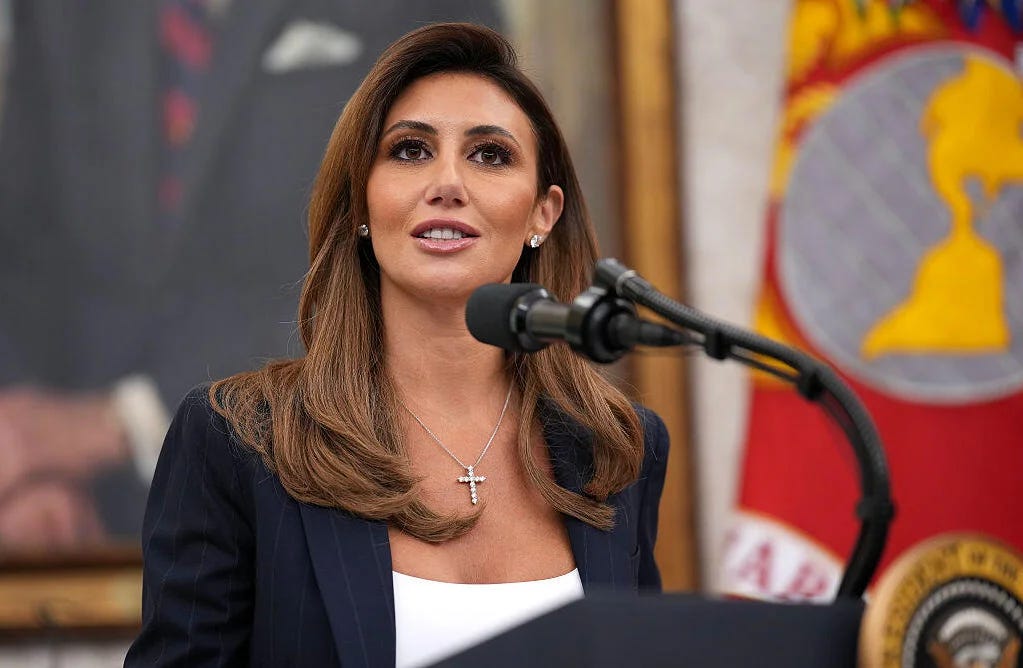
When Donald Trump made his former personal lawyer Alina Habba the top federal prosecutor in New Jersey, it was never about experience. It was about loyalty.
Now a federal appeals court has stepped in and said what Senate Democrats, career prosecutors and judicial watchdogs have been signaling for months: this appointment was not just controversial, it was illegal. In a unanimous decision, a panel of the Third Circuit Court of Appeals ruled that Habba was unlawfully installed as acting U.S. attorney for the District of New Jersey, upholding an earlier district court ruling that her tenure violated the rules that govern how these powerful positions are filled (Reuters, 2025; Associated Press, 2025).
This is more than a personnel dispute. It is a case study in how the Trump administration has tried to bend the federal justice system around the shape of one man’s political needs, and what happens when the courts finally say “enough.”
How Habba Got The Job
The story starts with a vacancy and a workaround.
After Trump took office, his team moved to replace the sitting U.S. attorney in New Jersey and elevate Habba, a lawyer best known for defending Trump in civil and political fights, not for running major federal prosecutions. She had never served as a federal prosecutor and had no record of managing a large office of criminal and civil divisions that handle everything from terrorism cases to public corruption investigations (The Guardian, 2025; New Jersey Monitor, 2025).
Under federal law, an interim U.S. attorney can serve for a limited period before the position must be filled through a Senate-confirmed appointment. In New Jersey, once Habba’s 120-day interim term expired, a panel of district court judges exercised their statutory authority to appoint her deputy, Desiree Leigh Grace, a career prosecutor, to take over while a permanent nominee moved through the confirmation process (Politico, 2025; Grace profile, 2025).
The Trump Justice Department responded by firing Grace almost immediately after the judges named her, then using a technical succession rule inside the department to keep Habba functionally in charge as “acting” U.S. attorney without sending her through the Senate at all (PBS, 2025; New Jersey Monitor, 2025).
That is the maneuver the appeals court has now rejected.
What The Court Actually Said
The Third Circuit did not rule on whether Habba is personally honest or capable. It focused on legality. The judges concluded that the administration’s effort to reinstall her after her interim term expired violated the statutory framework that governs vacancies. Once the 120-day limit ran out and the judges appointed a replacement, the Justice Department could not simply fire that replacement and recycle Habba into the job using internal succession rules (Reuters, 2025; Associated Press, 2025).
In plain language, the court found that Trump’s team tried to use a back door to keep a politically loyal prosecutor in power after the front door closed. That is not how the law works.
The ruling has real consequences. The court signaled that actions Habba took in the disputed period may be subject to challenge, injecting uncertainty into ongoing and past cases handled by her office. Federal criminal defendants and civil litigants now have a legal basis to question whether indictments, plea agreements or policy decisions made under her disputed authority are valid (Associated Press, 2025).
It is a rare moment where the judiciary is not just checking a president’s power in the abstract, but directly rejecting one of his handpicked prosecutors because the appointment itself broke the rules.
A Pattern Of Loyalists Over Law
Habba is not an isolated episode. The Reuters report notes that similar legal challenges have already unraveled other Trump appointed interim U.S. attorneys in places like California, Nevada and Virginia, where the administration pushed acting officials into extended roles without Senate confirmation (Reuters, 2025).
In New Jersey, the controversy was sharpened by Habba’s own record. During her short tenure she brought headline-grabbing charges against Democratic officials, including the mayor of Newark and a state legislator, that critics said looked more like political theater than neutral enforcement. Those charges were later dropped, and New Jersey’s Democratic senators Cory Booker and Andy Kim publicly opposed her permanent nomination, citing both lack of prosecutorial experience and concerns that she had politicized the office (The Guardian, 2025).
Legal analysts had also raised alarms about the way Trump and acting Attorney General Pam Bondi were using the Vacancies Reform Act and internal Justice Department rules as a kind of shell game, rotating loyalists into powerful positions while avoiding the scrutiny of public hearings and Senate votes (MSNBC analysis, 2025; Tully, 2025). The Habba decision is the most direct judicial rebuke of that strategy so far.
Why This Matters Beyond New Jersey
A U.S. attorney’s office is one of the most powerful instruments of the federal government. It controls prosecutions that can imprison people for life, destroy corrupt networks, or bury investigations that threaten the politically connected.
When that role is filled through backdoor maneuvers and loyalty tests instead of transparent, lawful appointment processes, the damage is not abstract. It hits real cases, real communities and real constitutional rights.
New Jersey is not an obscure jurisdiction. The office oversees critical financial crimes, organized crime cases, civil rights enforcement and public corruption investigations. If the public believes that the top prosecutor in that state is an unconfirmed political loyalist whose appointment could not survive judicial review, every decision coming out of that office carries a political shadow.
The appeals court’s ruling sends a clear message: presidents do not get to turn federal prosecutors into campaign surrogates simply by playing musical chairs with titles. There are rules, and those rules exist to protect the public from exactly this sort of manipulation (Reuters, 2025; Associated Press, 2025).
The Politics Around The Fallout
The decision also lands in the middle of a political fight. Judicial and legal reporting has already documented that some Republicans were eager to keep Habba in place precisely because of her loyalty to Trump and her willingness to carry out aggressive investigations aligned with his political agenda (The Guardian, 2025; MSNBC, 2025).
Senate Democrats, on the other hand, have insisted that any permanent U.S. attorney nomination for New Jersey must go through the full confirmation process, complete with public questioning about experience, independence and adherence to the rule of law. They used the traditional “blue slip” practice, which gives home state senators effective veto power over nominees, to block Habba’s confirmation long before the appeals court ruling (Politico, 2025).
By stepping in, the judiciary has effectively told both sides that there are limits to how far the executive branch can stretch vacancy rules, even in a polarized environment. The message is simple: if the White House wants a loyalist to run a federal prosecutor’s office for the long term, that loyalist needs to survive real scrutiny, not just internal political patronage.
A Test Case For The Rule Of Law
Alina Habba’s disqualification will not fix every problem inside the Justice Department. It will not magically depoliticize an era where presidents regularly treat the legal system as a battlefield.
What it does is set a precedent that will matter for every future administration, including this one. A president can try to stretch vacancy laws, nomenclature and internal succession charts to keep allies in charge of criminal prosecutions. But if those maneuvers collapse in court, the cost is high: chaos in ongoing cases, damaged public trust and a written ruling that becomes a roadblock for the next attempt.
New Jersey’s judges did their job when they used their statutory power to appoint a career prosecutor after Habba’s interim term expired. The Third Circuit did its job when it said the Justice Department could not simply erase that decision and reinstall a political favorite through creative paperwork. In a moment where so much of American law feels negotiable, this is one place where the answer was no.
For people who care about the rule of law, that matters. It shows that even when the executive branch tries to treat the Justice Department like a loyalty prize, there are still judges willing to defend the structure that keeps federal prosecutions tied to law rather than personal allegiance.
If you want more reporting that follows these fights inside the courts, tracks the documents and brings you the story without spin, support this work by subscribing, and if you are able, consider upgrading to a paid subscription so we can keep chasing the paper trail instead of the press releases.
References
Associated Press. (2025, December 1). Former Trump lawyer Alina Habba disqualified as New Jersey prosecutor, U.S. appeals court rules. AP News.
DiFilippo, D. (2025, July 22). Judges reject U.S. attorney’s bid to remain on the job, but White House blocks their order. New Jersey Monitor.
Guardian staff. (2025, July 22). Judges oust Trump ally Alina Habba as New Jersey’s top prosecutor. The Guardian.
Politico staff. (2025, July 22). Judges decline to keep Trump ally Alina Habba as New Jersey’s top prosecutor. Politico Pro.
Reuters. (2025, December 1). Court disqualifies Trump ally Habba as top New Jersey federal prosecutor. Reuters.
Tully, T. (2025, July). Bypassing Habba, judges in New Jersey name new top federal prosecutor. The New York Times.
PBS. (2025, July 25). Alina Habba still New Jersey’s top law enforcement official. NJ Spotlight News, PBS.
WHAT TO READ:
Kristi Noem Defied a Federal Judge. Now the Trump Administration Faces a Full-Blown Constitutional Confrontation.
On Sunday morning, in a television interview that should have sent shockwaves across Washington, Homeland Security Secretary Kristi Noem confirmed what the Department of Justice had already hinted at in federal court filings. She acknowledged that she personally authorized deportation flights of Venezuelan detainees to El Salvador after a U.S. district …
Trump Scrambles to Rewrite the Hegseth Strike Scandal as Republicans Join the Oversight Push
This Substack is reader-supported. To receive new posts and support my work, consider becoming a free or paid subscriber.
Kristi Noem Collides With Reality: The DC Shooter’s Asylum Was Approved Under Trump
This Substack is reader-supported. To receive new posts and support my work, consider becoming a free or paid subscriber.


