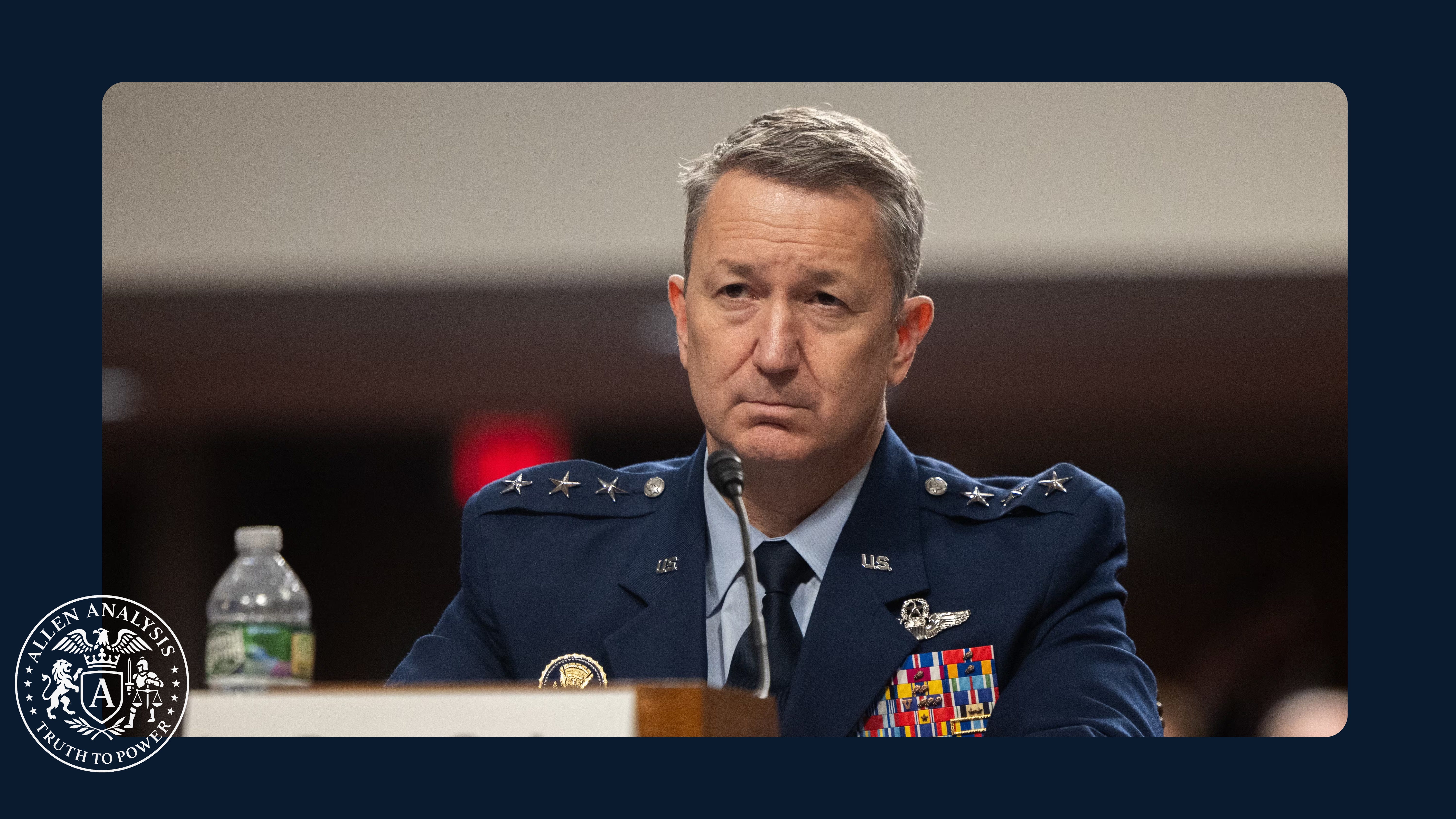
The Disappearing General: Why the Chairman of the Joint Chiefs Vanished During Trump and Hegseth’s Caribbean Strikes
General Dan Caine, the most powerful military officer in America, has not been seen since the Caribbean strikes ignited international outrage.
The most important figure in the United States military has vanished at the worst possible moment.
General Dan Caine, Chairman of the Joint Chiefs of Staff, has not appeared publicly since the controversial Caribbean strikes ordered under Donald Trump and Defense Secretary Pete Hegseth. No briefings. No press gaggles. No off-the-record assurances to reporters. Nothing.
This is not a man who disappears. This is the officer legally responsible for advising the president on the use of lethal force. The chairman does not go quiet during a crisis unless something is deeply, structurally wrong.
According to reporting from Raw Story, senior Pentagon officials are “deeply concerned” that the strikes were unlawful and that the normal chain of military consultation was sidestepped (Raw Story, 2025). For the top brass, Caine’s silence is not just unexplained. It is unprecedented.
The disappearance of the nation’s highest-ranking officer is becoming a bigger story than the strikes themselves.
The Crisis That Swallowed the Chairman
The timing matters. General Caine’s disappearance began immediately after the world saw the images that changed the narrative: two men clinging to splintered debris after a U.S. aircraft destroyed their fishing vessel.
They said there were no drugs on board. No warning. No attempt to board or search. No immediate rescue.
Their story was soon followed by reports of a second strike that killed more than a dozen people. Human rights groups in the region accused the United States of “extrajudicial executions.” Governments in Colombia and Venezuela demanded independent investigations (“2025 United States military strikes,” 2025).
This was the moment the chairman should have emerged to steady the country. To explain the intelligence picture. To defend the legality of the operation. Or to signal concern.
Instead, he vanished.
Why His Absence Terrifies the Pentagon
In the U.S. system, the chairman cannot launch attacks. He cannot order troops into combat. What he can do, and must do, is advise whether an order is lawful.
If Caine objected to the mission.
If he warned the White House.
If he refused to put the Joint Chiefs’ signature behind the operation.
That would explain everything.
It would explain the sudden silence.
It would explain the panic inside the Pentagon.
It would explain why defense officials began leaking almost immediately.
One source told Raw Story that the upper ranks believed the operation lacked proper legal grounding and may have bypassed the institutional safeguards designed to prevent exactly this scenario.
They have good reason to worry. Senator Rand Paul reviewed what is publicly known and declared bluntly that “both strikes are actually illegal” (Responsible Statecraft, 2025).
Paul said something else that now hits much harder in light of the missing chairman.
“We do not kill every suspected boat off Miami and say ‘whoops’ when they did not have any drugs.” (Responsible Statecraft, 2025)
If the chairman agreed with that sentiment, even privately, it would put him on a collision course with Trump and Hegseth.
And in this administration, disagreement is a liability.
The Legal Frame: What Caine Would Have Been Asked to Endorse
International and U.S. law both require that lethal force outside declared battlefields meet strict criteria.
Necessity.
Imminent threat.
Proportionality.
Distinction between combatants and civilians.
None of these requirements appears to have been met. According to the survivors’ accounts, their vessel was attacked without warning, and no evidence of narcotics was found afterward (“2025 United States military strikes,” 2025). Legal analysts say the strikes look less like interdiction and more like airborne executions.
Human rights investigators have warned that the conduct mirrors patterns condemned in previous cases.
“Experts, human rights groups and international bodies said the killings were illegal under U.S. and international law.” (“2025 United States military strikes,” 2025)
The chairman of the Joint Chiefs could not endorse such an action without creating a written record of his complicity.
And if he refused, Trump and Hegseth may have proceeded without him.
Which raises the most dangerous question of all.
Was the Chairman Cut Out of the Chain of Command?
If General Caine was sidelined.
If the strikes were ordered through political channels rather than military ones.
If the Pentagon were presented with a pre-decided plan rather than consulted in advance.
Then the United States is facing a constitutional crisis masquerading as a foreign policy scandal.
Raw Story’s reporting indicates that senior officers fear precisely this scenario. The strikes appear to have come from a tight political circle inside the White House, not from the structured decision-making process expected during lethal operations.
The chairman's disappearance at the same moment is a neon warning sign.
It suggests more than disagreement. It suggests refusal.
It suggests that the highest-ranking military officer in the United States may have attempted to prevent an unlawful act, failed, and then was removed from visibility.
Until we hear from him directly, that possibility is not speculation. It is the only hypothesis that fits the timeline.
Pete Hegseth’s 2016 Words Now Boomerang
In 2016, long before he became defense secretary, Hegseth made a statement during a televised debate about war crimes that is now haunting him. He insisted that American troops have a duty to refuse unlawful orders.
“If an order is illegal, soldiers not only can refuse, they must refuse.” (Hegseth, 2016, as cited in Raw Story, 2025)
He added that “there are consequences” for carrying out unlawful commands.
That standard applies to him now.
And it applies with equal force to any attempt to push the chairman aside to carry out an unlawful strike.
If Caine refused.
If he warned.
If he objected.
Then the consequences Hegseth described fall on him and the president, not the junior officers who carried out the mission.
Congress Is Now Watching the Chairman’s Silence
Senator Rand Paul is not alone in questioning the legality of the strikes. Members of both parties have begun demanding clarity on the chain of command. They want to know whether military lawyers reviewed the operation. They want to know whether the chairman concurred. They want to know whether Trump and Hegseth bypassed the rules of engagement.
Congress has the constitutional authority to restrict or revoke the president’s use of force powers. Paul has already signaled he intends to push for hearings (Evrimagaci, 2025).
Those hearings cannot proceed without the chairman.
Which means the moment General Caine reappears, whether voluntarily or under subpoena, will determine the trajectory of the crisis.
If he confirms he was cut out, the political fallout will be historic.
If he indicates he objected, the strikes become indefensible.
If he says nothing, the silence itself becomes an indictment.
The Country Is Now Waiting on One Man
There is no modern precedent for the sudden disappearance of the chairman of the Joint Chiefs during a legally questionable military operation. Not during Vietnam. Not during Iraq. Not during the War on Terror.
Generals do not vanish.
Unless something has gone wrong at the core of American command authority.
The White House insists nothing is abnormal. The Pentagon refuses to elaborate. But the absence of the military’s top officer is impossible to ignore.
This crisis no longer revolves around two strikes in the Caribbean.
It revolves around a single question that only one man can answer:
Was the United States military ordered to carry out an unlawful operation without the approval of its highest-ranking officer?
Until General Caine steps forward, the country remains suspended in uncertainty, and the alarm inside the Pentagon grows louder.
Because if the chairman was overridden once, he can be overridden again.
And the next strike may not be in the Caribbean.
References
Evrimagaci. (2025). Rand Paul challenges legality of Trump’s Caribbean strikes. https://evrimagaci.org
Raw Story. (2025). Military’s top brass worried as highest-ranking officer disappears amid crisis.
Responsible Statecraft. (2025). Congress warned Caribbean strikes may violate U.S. and international law. https://responsiblestatecraft.org
Wikipedia. (2025). 2025 United States military strikes on alleged drug traffickers. Retrieved November 2025.
READ MORE:
Aftyn Behn Lost Tennessee’s 7th – But Democrats Just Shaved A 22-Point Trump District Down To Single Digits
Aftyn Behn did not win Tennessee’s 7th Congressional District tonight. Republican Matt Van Epps will be the next member of Congress from a district that has been safely in GOP hands for years. On paper, that sounds like business as usual in a district Donald Trump carried by roughly twenty-plus points in 2024.
Rand Paul Breaks With Trump and Hegseth, Calling the Caribbean Strikes “Actually Illegal”
Senator Rand Paul did what almost no Republican in the Trump era has dared to do. He accused the President and his Defense Secretary, Pete Hegseth, of violating federal law. In a brief but remarkable interview, Paul declared, “I think both strikes are actually illegal.” His statement came after new disclosures revealed that the United States conducted o…