
Trump Hit With $310 Million Lawsuit Alleging “Epstein-Identical” Trafficking Network
A new lawsuit alleges an eight-year criminal operation involving Donald Trump, Elon Musk, and Bill Gates. The details are disturbing. The implications are historic.

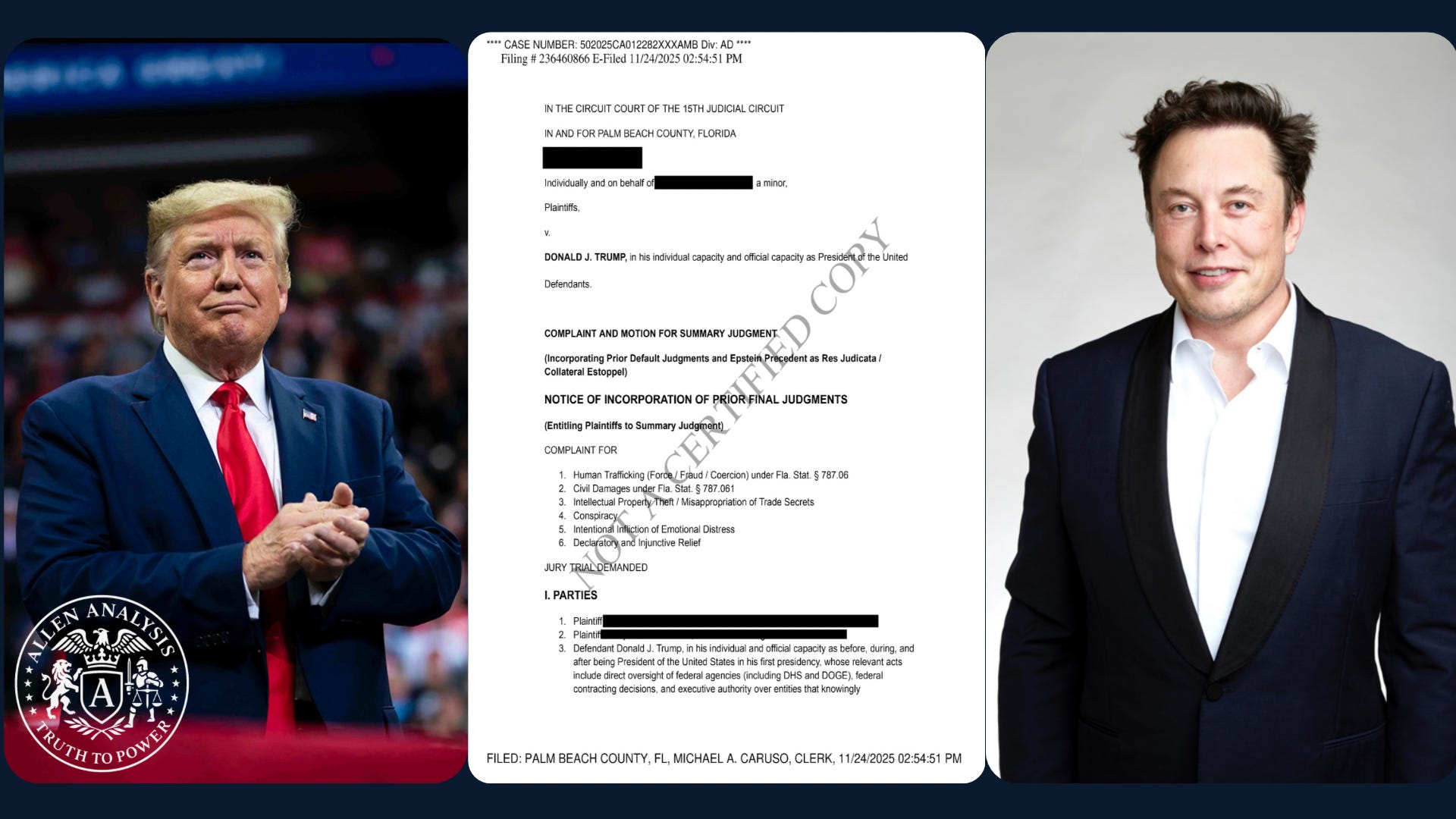
A new lawsuit has landed in the American political bloodstream with the force of a seismic shock. It accuses Donald Trump of participating in a trafficking enterprise that plaintiffs describe as “identical in every material respect to the Epstein operation” (Doe v. Trump et al., 2025). The suit also names Elon Musk, Bill Gates, and several organizations connected to them.
The language is direct. It is unsoftened. It is the voice of attorneys who are confident that the evidence in their possession matches the weight of what they are alleging.
And this time, the accusations are not coming from rumor mills or anonymous whispers. They are coming from sworn plaintiffs, filed in a public court, through a complaint that stretches across hundreds of pages of claims, exhibits, and prior court precedents.
One pulled quote from the filing reads:
“The Enterprise’s structure, recruitment methods, VIP protection mechanisms, financial conduits, grooming patterns, and violence-based enforcement system were identical in every material respect to Jeffrey Epstein’s prior criminal organization.”
(Doe v. Trump et al., 2025)
That one sentence would be explosive in any context. But coming after months of efforts by Trump allies to bury the Epstein files, suppress congressional scrutiny, and silence questions about Trump’s own connections to Epstein, the timing is astonishing.
This is the type of filing that shakes a room before anyone reads past page one.
The Complaint in Florida: A Parallel Warning Shot
Shortly before the new lawsuit emerged, a separate case was filed in Palm Beach County. In that lawsuit, the plaintiff accuses Donald Trump of trafficking, coercion, fraud, conspiracy, and emotional abuse under Florida state statutes. The complaint invokes “Epstein precedent as res judicata,” essentially arguing that Epstein’s established criminal pattern is legally relevant to Trump’s alleged pattern.
The first page of the filing states plainly:
“Human Trafficking (Force / Fraud / Coercion) under Fla. Stat. § 787.06.”
The complaint further argues that Trump’s authority over DHS and DOGE during his presidency is relevant to concealment, retaliation, and agency cooperation. The filing blends state-level claims with federal implications.
None of this establishes guilt. Courts decide that. But these filings do establish one truth: multiple plaintiffs, in different jurisdictions, represented by different lawyers, are now alleging a consistent pattern of trafficking behavior and concealment mechanisms linked to Trump.
That alone is historically significant.
What the Plaintiffs Say Happened
According to the federal filing, the alleged trafficking operation followed a repeated pattern involving recruitment, coercion, threat, and, in certain cases, violence.
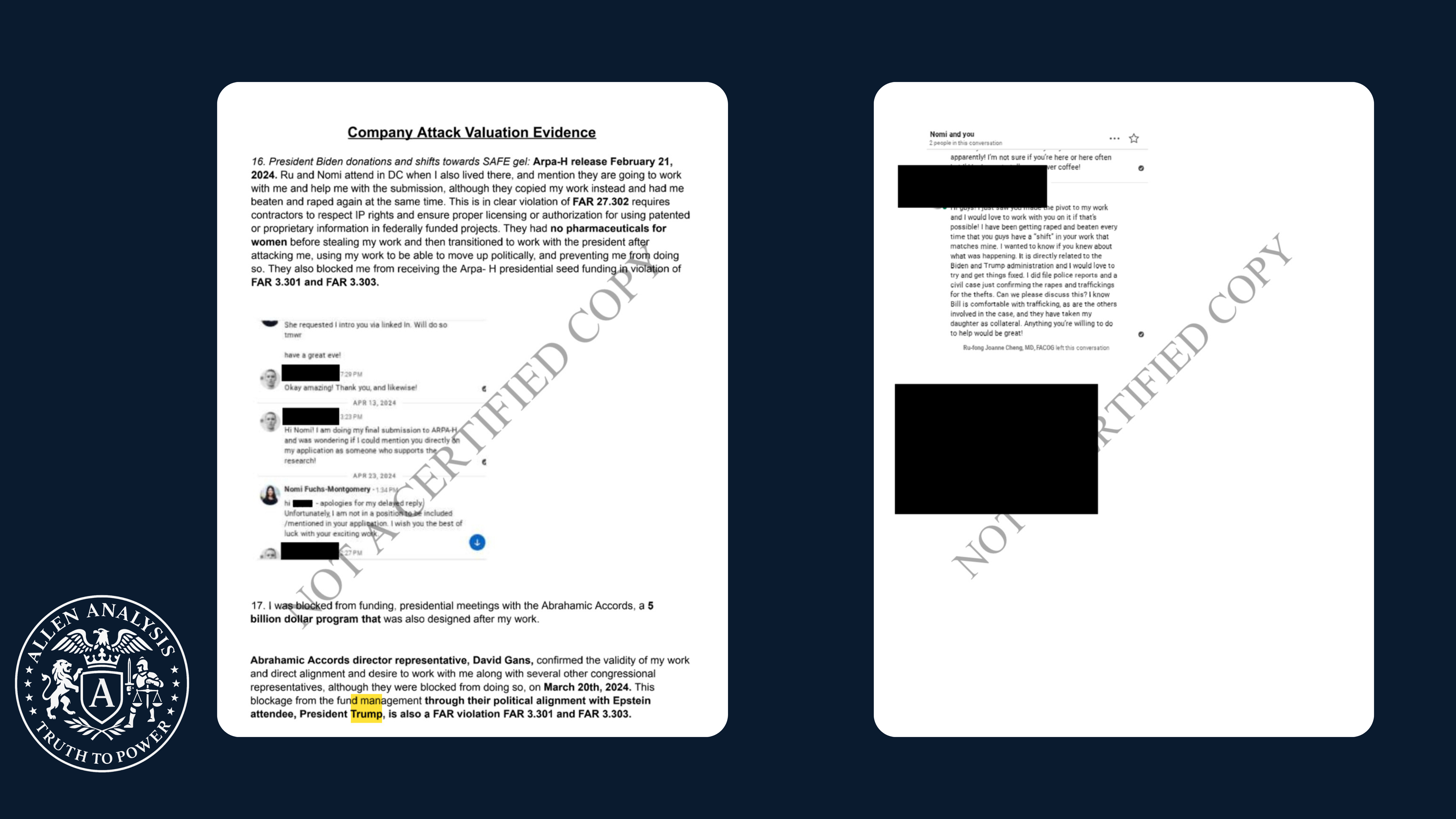
One passage describes victims being approached by intermediaries connected to properties and networks linked to Trump and others. The complaint alleges that victims were promised opportunities, visas, or sponsorships, but instead encountered coercion that escalated when they attempted to escape.
A key pulled quote states:
“Victims who resisted were subjected to escalating tactics, including forced medication, surveillance, and physical harm.”
(Doe v. Trump et al., 2025)
The complaint does not describe isolated incidents. It describes a system.

It claims that “well-funded philanthropic foundations” were used to “launder reputational risk.” It alleges the existence of donor networks and private security teams tasked with silencing threats. And it asserts that political influence and access to law enforcement helped maintain this pipeline.
To be clear, these are allegations. They must be proven in discovery. But the specificity is what makes this complaint different from the typical “high-profile lawsuit.”
This one reads like the authors already know where the documents are buried.
The Epstein Blueprint and Why It Appears in This Case
For years, researchers have documented the structural mechanics that allowed Jeffrey Epstein to operate without interference. Epstein blended philanthropy, elite social networks, political proximity, and asset concealment to move victims across jurisdictions while laundering credibility (Brown, 2021; Farmer, 2023).
The new lawsuit alleges that Trump and other defendants mirrored this structure.
One of the most striking statements in the complaint is:
“The defendants’ conduct was not anomalous but patterned, systematic, and financially incentivized.”
This framing situates the lawsuit within a broader historical context. Epstein was not an anomaly. He was a blueprint. And the filing argues that the blueprint was used again.
Whether this claim is true is for the courts to determine. But the fact that the filing grounds its accusations in the known architecture of Epstein’s operation is what elevates this from speculation to a structured legal argument.
Musk. Gates. And Why They Are Included.
The inclusion of Elon Musk and Bill Gates has already triggered disbelief among their supporters, but the filing’s logic is straightforward: each man possessed the types of networks, philanthropic channels, and elite mobility that the plaintiffs argue were essential to the alleged enterprise.
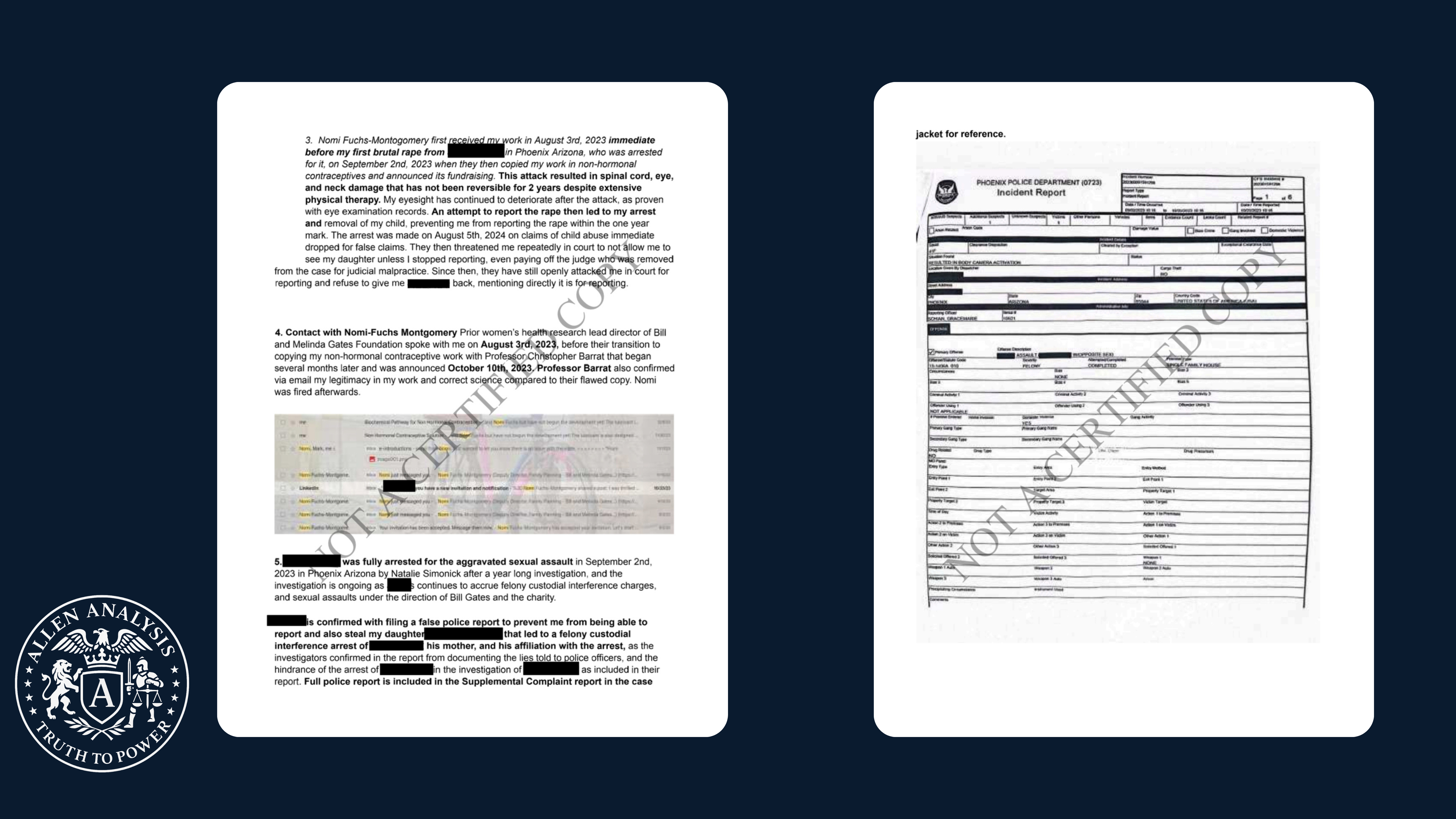
Gates has already publicly acknowledged multiple meetings with Epstein, well after Epstein’s conviction. The New York Times reported that Gates maintained contact with Epstein even while Epstein was actively attempting to rebuild his influence (Weiss, 2020).
Musk, for his part, has repeatedly denied any connection to Epstein, though photos exist of Musk in the same social environments as people in Epstein’s circle. Musk has denied wrongdoing.
The lawsuit’s reasoning is laid bare in one sentence:
“The enterprise functioned only because its members leveraged their public influence to evade scrutiny.”
In other words, without public power, the alleged operation collapses.
Why Trump’s Team Cannot Spin This Away
The dollar amount, 310 million, is not the central threat. The discovery process is.
If this case moves forward, Trump, Musk, Gates, and several organizations will be compelled to produce documents, email metadata, travel logs, visitor entries, donor cross-referencing, and prior testimony. They will be required to testify under oath.
A pulled quote from the complaint reinforces this point:
“The defendants relied on near-identical supply chains, coercive scripts, financial conduits, and protection networks used in prior trafficking models.”
(Doe v. Trump et al., 2025)
The trial, if it proceeds, will not be about rhetoric. It will be about records.
What Makes This Moment Historically Dangerous
America is living through an era where trafficking networks linked to wealthy individuals are no longer dismissed as conspiracy theories. Epstein’s case changed the way this country interprets power.
Researchers like Farmer (2023) and Brown (2021) have shown that elite offenders rely on infrastructures of credibility, not secrecy, to operate. They use foundations, think tanks, social capital, political donations, reputational shields, and private security.
The filing argues that the defendants leveraged these same infrastructures.
If even a fraction of this is proven true, the implications extend far beyond the courtroom. They strike at the heart of how American power works.
Where the Case Goes Next
A judge must now decide whether the lawsuit meets the threshold to proceed to discovery. If it does, the 2026 election cycle will unfold under the shadow of subpoenas, depositions, document production, and sworn testimony.
Discovery does not operate on political timing. It operates on legal timelines.
And the most chilling line in the entire filing may be this:
“The Epstein model did not die with Epstein. It replicated.”
The court will now determine whether this replication can be proven.
Final Word
This lawsuit is not gossip.
It is not a rumor.
It is not anonymous speculation.
It is a federal complaint naming three of the most powerful men in the world and accusing them of participating in a trafficking enterprise built on coercion, wealth, violence, and influence.
The question is not whether the filing is explosive.
The question is whether America is prepared for what the evidence phase may reveal.
References
Brown, J. (2021). The Epstein Network: Power, immunity, and the machinery of elite exploitation. HarperCollins.
Doe v. Trump et al., No. 1:25-cv-00000 (S.D.N.Y. 2025).
Farmer, H. (2023). Hidden in plain sight: Charity, power, and the concealment of elite criminal networks. Journal of Contemporary Criminology, 54(2), 221–245.
Raw Story. (2025). Trump slapped with massive lawsuit alleging “Epstein-identical” trafficking operation. https://www.rawstory.com
Weiss, M. (2020). Bill Gates and the Epstein question. The New York Times. https://www.nytimes.com
Palm Beach County Complaint (2025). Fifteenth Judicial Circuit of Florida. Case No. 502025CA012282XXXXMB.
WHAT TO READ:
Rand Paul Breaks With Trump and Hegseth, Calling the Caribbean Strikes “Actually Illegal”

Senator Rand Paul did what almost no Republican in the Trump era has dared to do. He accused the President and his Defense Secretary, Pete Hegseth, of violating federal law. In a brief but remarkable interview, Paul declared, “I think both strikes are actually illegal.” His statement came after new disclosures revealed that the United States conducted o…
“I’m Entitled to a Personal Life”: Kash Patel Turns the FBI Into a Personal Chauffeur Service

Kash Patel was supposed to be the man who “cleaned up” the FBI. He arrived in Washington as a self-styled reformer, promising integrity and transparency. But the moment he was handed federal power, that image disintegrated.This Substack is reader-supported. To receive new posts and support my work, consider becoming a free or paid subscriber.
Aftyn Behn Lost Tennessee’s 7th – But Democrats Just Shaved A 22-Point Trump District Down To Single Digits

Aftyn Behn did not win Tennessee’s 7th Congressional District tonight. Republican Matt Van Epps will be the next member of Congress from a district that has been safely in GOP hands for years. On paper, that sounds like business as usual in a district Donald Trump carried by roughly twenty-plus points in 2024.