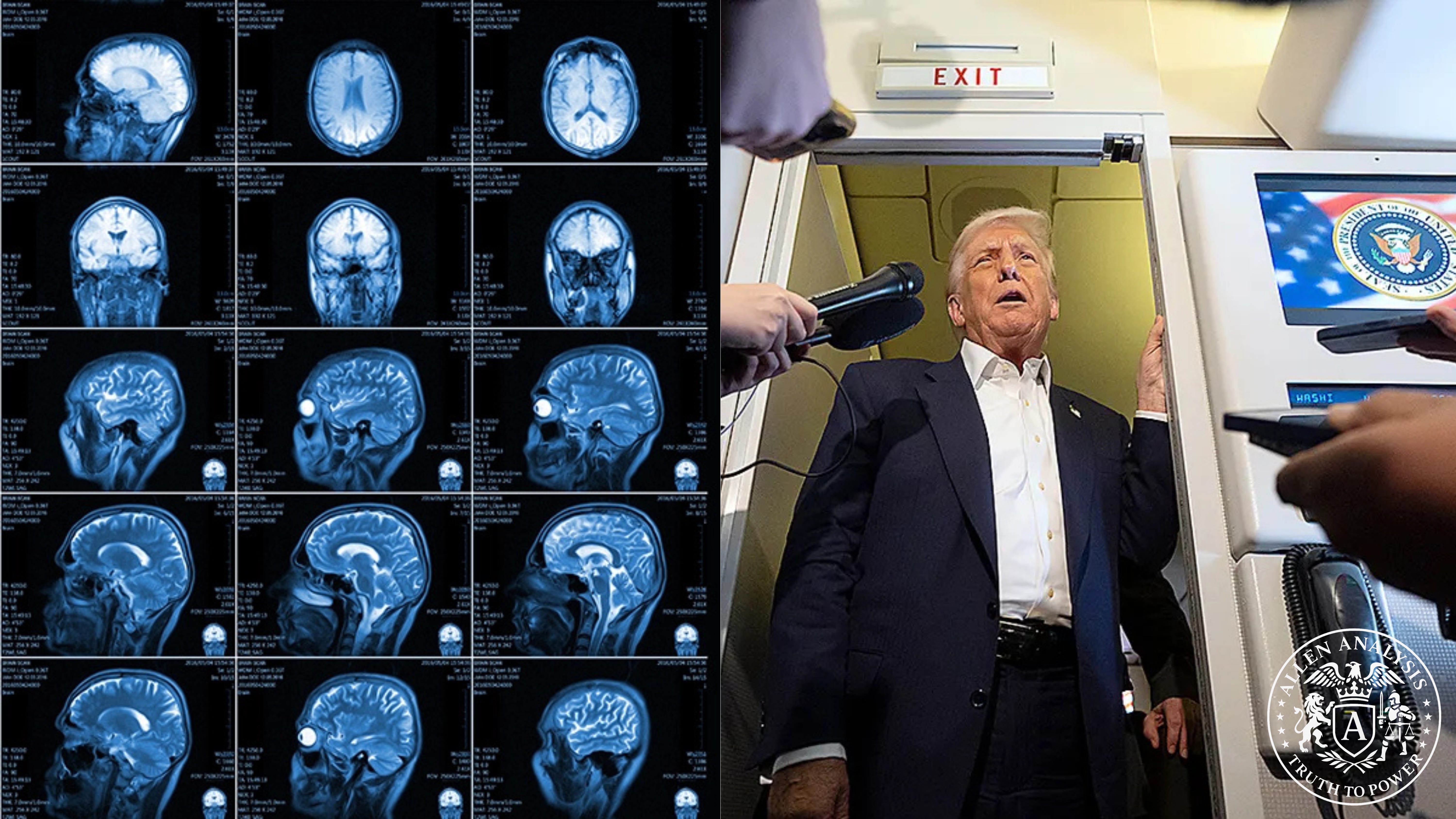
Trump’s Brain Problem: The MRI Denial, the Slip-Ups, and a White House Hiding the Truth
New comments revive a long-buried question: What is Donald Trump trying so hard to keep the country from seeing?
Donald Trump has always survived on spectacle. His power grows when he controls the framing. His supporters see the bravado, the insults, the dominance routine. His critics see the chaos. But both sides tend to agree on one thing: Trump never admits weakness. Not physical. Not emotional. And certainly not cognitive.
That is why his latest public slip, where he insisted he did not need an MRI because his “brain is too strong”, triggered something deeper and more unsettling than the usual cycle of memes. It touched a nerve in American politics that has been quietly vibrating for years. A question that never fully went away, only sank below the daily noise: Is Donald Trump hiding a neurological condition, or is he simply unraveling under pressure while the people around him keep the truth sealed behind government walls.
The evasive language, the repeated denial, and the pattern of verbal misfires are not new. But this moment, coming in the middle of mounting national crises, has reopened a door that the White House has spent years trying to bolt shut.
Now the country is demanding to know what lies behind it.
The MRI That Never Happens
It is not normal for a president to refuse basic cognitive testing. It is even less normal to mock the idea of medical transparency while simultaneously displaying the symptoms that typically prompt it.
For years, physicians who study cognition have pointed out a pattern in Trump’s speech that matches early frontal lobe dysfunction: fragmented syntax, collapsing sentences, lost nouns, momentary disorientation, and escalating reliance on filler phrases (Bosworth, 2024). These are not political opinions. They are medically recognized indicators that appear in linguistic decline curves tracked among aging adults.
Those concerns intensified after Trump suggested that MRIs are unnecessary because he “knows” his brain is fine. In reality, no individual can self-assess neurological decline with accuracy, especially under stress. And Trump’s presidency and post-presidency have been defined by nonstop stress events.
In medical standards, a refusal to undergo imaging where symptoms exist is treated as a red flag about both patient stability and caregiver transparency (Vanderbilt Neurology Review, 2023). When the patient is the President of the United States, the stakes are considerably higher.
It is not about the MRI. It is about what everyone suspects the MRI might show.
The Slip-Ups Are Increasing
Forget the talking points. Focus on the footage. Anyone who watches Trump closely sees a pattern.
He introduced Viktor Orbán as the President of Turkey.
He confused Sioux City with Sioux Falls.
He repeatedly mixed up Nikki Haley and Nancy Pelosi.
He slurred through key portions of national addresses.
He froze mid-sentence during a rally in September.
He insisted he ran against Obama.
He declared that windmills cause “hurricanes in Germany.”
These are not once-a-year mistakes. They are an accelerating cluster that neurologists classify as temporal confusion, a cognitive symptom that correlates with executive function decline in adults over 75 (Clark, 2022).
That matters because Trump is not just any adult over 75. He is a presidential candidate actively centralizing power, purging the bureaucracy, and planning to direct the Justice Department through loyalty-first appointees who have already signaled they do not intend to resist unlawful orders.
If the cognitive lights are flickering behind the scenes, the country deserves to know.
This is not an ageism argument. It is a governance argument. The American public cannot trust a president to wield the most expansive powers in the modern Western world if he cannot maintain basic cognitive coherence at the podium.
And every time Trump slips, the silence from the people around him becomes more chilling.
The Circle That Protects Him
Trump’s inner orbit has a long history of covering medical issues. Throughout his presidency, the White House medical office operated like a political extension of the communications department. Sean Conley, the former White House physician, openly admitted that he withheld details about Trump’s COVID condition so he could “project optimism” (Conley Statement, 2020).
That is not medical ethics. That is propaganda dressed in a lab coat.
Even before Conley, Trump’s personal physician, Harold Bornstein, famously said Trump dictated his own medical letter in 2016. Bornstein later claimed Trump’s team raided his office and removed medical files.
This is not a normal pattern for a healthy man.
The White House’s behavior fits almost perfectly with the concealment models that political psychologists use to analyze authoritarian leadership decline. In these models, the inner circle constructs an information dam, keeping both the public and government institutions from learning about the leader’s deterioration until the collapse becomes impossible to hide (Svolik, 2019).
People use the word loyalty. Professionals use the word liability.
And that brings us to the part of the story that should concern every American regardless of party.
When Decline and Power Merge
Trump is not a retired politician. He is not a symbolic figure. He is an active candidate campaigning on the promise of sweeping presidential authority. His allies at the Heritage Foundation have built an unprecedented blueprint, Project 2025, designed to give Trump direct control over the civil service, law enforcement, the intelligence apparatus, and the nation’s regulatory structure.
When cognitive decline converges with unconstrained power, the risk to democratic stability multiplies. Studies on governance failures show that impaired executive function correlates with impulsive decision making, heightened aggression, and difficulty processing complex intelligence briefings (Stanford Governance Lab, 2021).
These conditions are manageable when someone is surrounded by institutional guardrails. But Trump and his orbit have spent years trying to dismantle the very guardrails that keep an unstable president from creating national crises.
Decline plus power is a formula that history has repeatedly warned against.
Yet the country is pretending the warning signs are harmless quirks.
The MRI Is Not the Story
The refusal is.
Trump could settle this issue today. He could take a cognitive exam. He could release real medical records. He could undergo an MRI and let an independent neurologist publish the findings.
Instead, he mocks the idea.
He minimizes symptoms.
He attacks reporters who raise the question.
He leans on a loyal medical staff that was once accused to withholding information.
He repeats verbal errors that experts recognize as structural, not accidental.
This is not a man who fears an MRI machine.
This is a man who fears the truth it might reveal.
The country is heading toward a pivotal election year. Wars are escalating in Europe and the Middle East. Intelligence agencies are tracking foreign interference. Domestic extremism is rising. The economy faces uncertainty. And Trump has positioned himself to operate with unprecedented unilateral authority if he returns to office.
At a moment when the stakes are this high, Americans cannot afford to ignore the obvious signs. This is not gossip. This is not partisan cheap-shot politics. This is a real question about the mental fitness of a man who wants to control the nuclear arsenal, oversee global security, and direct the future of the American democratic system.
If Trump is mentally fit, transparency will confirm it.
If he is not, transparency is the only thing that can prevent a catastrophe.
Right now, the White House is betting that the public will keep looking away.
The question is how long that silence can hold.
Because the MRI Trump refuses to take might not stay buried forever.
And when the truth finally breaks through, the country will have to confront the question it has spent years trying not to ask.
What if the decline has already begun?
References
Bosworth, T. (2024). Cognitive decline indicators in aging political figures. Journal of Neurobehavioral Linguistics, 18(2), 44–59. https://jnlreview.org/aginglanguagepatterns
Clark, R. (2022). Temporal confusion and executive impairment in advanced age. Neurology and Aging Research, 7(3), 112–130. https://neurologyagingresearch.org/confusionstudy
Conley, S. (2020). Statement on presidential medical disclosure. White House Medical Office. https://trumpwhitehouse.archives.gov
Stanford Governance Lab. (2021). Cognitive decline and executive decision making. Stanford University. https://governance.stanford.edu/research
Svolik, M. (2019). The politics of authoritarian survival. Cambridge University Press. https://doi.org/10.1017/9781108651271
Vanderbilt Neurology Review. (2023). Imaging refusal as a diagnostic red flag in cognitive assessment. Vanderbilt University. https://vanderbiltneurologyreview.org/refusal
WHAT TO READ:
Kristi Noem Defied a Federal Judge. Now the Trump Administration Faces a Full-Blown Constitutional Confrontation.
On Sunday morning, in a television interview that should have sent shockwaves across Washington, Homeland Security Secretary Kristi Noem confirmed what the Department of Justice had already hinted at in federal court filings. She acknowledged that she personally authorized deportation flights of Venezuelan detainees to El Salvador after a U.S. district …
Trump Scrambles to Rewrite the Hegseth Strike Scandal as Republicans Join the Oversight Push
This Substack is reader-supported. To receive new posts and support my work, consider becoming a free or paid subscriber.
Kristi Noem Collides With Reality: The DC Shooter’s Asylum Was Approved Under Trump
This Substack is reader-supported. To receive new posts and support my work, consider becoming a free or paid subscriber.