1. Impeachment Is Back On The Table
Rep. Al Green didn’t tiptoe into the moment; he walked up to the mic and said he’ll introduce new articles of impeachment against Donald Trump before Christmas. In any normal democracy, that sentence alone would be historic. In this one, it’s just the logical next chapter.
You’ve now got a president under federal investigation, accused of weaponizing the DOJ, blocking the Epstein files, and openly fantasizing about political executions. The Green announcement reframes all of that as not just scandalous, but impeachable. It puts Congress on notice: if they sit on their hands while a man who talks about killing opponents also controls federal law enforcement, they’re not neutral, they’re complicit.
Practically, this sets up a collision between the impeachment track and the Epstein-files fight. If the articles are framed around abuse of power, obstruction, and incitement, Trump’s public record already does half the prosecutor’s job. The question is whether Democrats and the small handful of non-MAGA Republicans are willing to move from statements to subpoenas.
2. “Pick A Fking Side”: Murphy Breaks The Spell
Sen. Chris Murphy finally said the quiet part at full volume: if you hold any influence in this country and you’re still pretending Trump’s execution talk is “just rhetoric,” you’re part of the problem.
After Trump spent the weekend calling Democrats “enemies punishable by death,” Murphy’s line, “maybe it’s time to pick a fking side,” wasn’t just a soundbite. It was a litmus test. Either you accept that openly dangling death as a punishment for political disagreement is disqualifying in a supposed democracy, or you’re signaling that you’ll live with it as long as it’s pointed at your enemies.
This is where elites love to hide behind process talk. They’ll mumble about “heated language on both sides” and “lowering the temperature,” as if the issue is tone and not the president floating medieval punishments for his opposition. Murphy’s outburst cuts through that fog. The choice is simple: rule of law or rule by threat.
3. Chicago’s “Terrorist” Who Wasn’t
In Chicago, the mask slipped. A Latina woman was shot five times by Trump’s border agents, then slapped with “terrorism” charges to justify what they did to her. Agents claimed she rammed them with a car and pulled a gun.
The tape said otherwise. Video showed they hit her first, and the gun never left the holster. Now every charge has been dropped.
That’s not a paperwork mistake. That’s the state manufacturing a threat, nearly killing an innocent woman, and then trying to bury her under a “terrorist” label so nobody would ask questions. This is exactly why you don’t hand law enforcement a blank check wrapped in national-security language. Once “terrorism” becomes a magic word you can slap on anyone you’ve already harmed, oversight is dead.
It also tells you something about hierarchy of sympathy. The system bent over backward to believe armed officers with conflicting stories, and only backed off when video evidence boxed them in. If that footage didn’t exist, she’d likely be in prison right now and the official story would still be that she “lunged” first.
4. “Just Shoot Them”: Esper’s Reminder About Unlawful Orders
The resurfaced 60 Minutes clip of former Defense Secretary Mark Esper describing Trump asking if the military could “just shoot” protesters is not old news, it’s a live warning.
Esper’s testimony underlines why military professionals have to be trained, repeatedly, to say no to unlawful orders. When the commander in chief sees the armed forces as a personal crowd-control squad, the only thing standing between a bad idea and a massacre is the spine of the people in uniform.
Trump’s people are now out front insisting every order he gives is lawful by definition. Pair that with this footage and you see the architecture of authoritarianism forming in real time: a leader who casually suggests lethal force against civilians, surrounded by spokespeople who treat any pushback as treason.
If you ever wondered why legal guardrails like the War Powers Act and the Uniform Code of Military Justice matter, here’s your answer. Without them, the only barrier between protesters and live rounds is the president’s mood.
5. The Leavitt Doctrine: Every Order Is Legal, Questioning It Is Treason
Karoline Leavitt walked up to the White House podium and gave the purest version of Trumpism you’ll ever hear.
Asked if Trump’s talk of Democrats committing “sedition punishable by death” meant he wanted to execute members of Congress, she responded with the standard two-step: deny intent, then pretend the words don’t matter. Float the threat, disavow the literal reading, and act offended anyone took it seriously. That’s how you move political assassination from unthinkable to “just rhetoric” in under a week.
Then she went further. When pressed about lawmakers warning troops not to follow illegal orders, she claimed Democrats were encouraging soldiers to disobey “lawful orders” and declared, on camera, that “every order the president gives is lawful.”
That is the core of the problem. If every presidential command is presumed lawful on arrival, there is no such thing as an unlawful order. Soldiers become props, not professionals. Any refusal to carry out a clearly illegal command can be smeared as insubordination. That’s not how a democracy talks about the chain of command. That’s how regimes talk when they’re getting comfortable with the idea of violence.
6. Kaitlan Collins vs. The Fake Quote Machine
The most revealing moment wasn’t at the podium, it was as Leavitt tried to walk off. Kaitlan Collins called after her and calmly pointed out that the Democrats Leavitt attacked in that viral clip were misquoted. “That’s actually not what they said.”
In twenty seconds, you get the entire dynamic. The White House comms shop leans on fake quotes to paint Democrats as extremists who want a rogue military. The press, if it does its job, can puncture the balloon in real time. When your entire defense of the president depends on putting words in his opponents’ mouths, it tells you everything about how defensible the real record is.
Leavitt’s refusal to engage, and the quick exit, are the point. The lie gets pumped out in front of the cameras; the correction happens as a shouted afterthought while she’s halfway out the door. That asymmetry is how disinformation wins if people aren’t paying attention.
7. Epstein’s Orbit: The Ehud Barak Allegation
Virginia Giuffre’s allegation that she was left bloodied and beaten by former Israeli Prime Minister Ehud Barak and that this attack marked the “beginning of the end” of Epstein’s control, is not tabloid fodder. It’s an allegation that a former head of government was personally entangled in the abuse network.
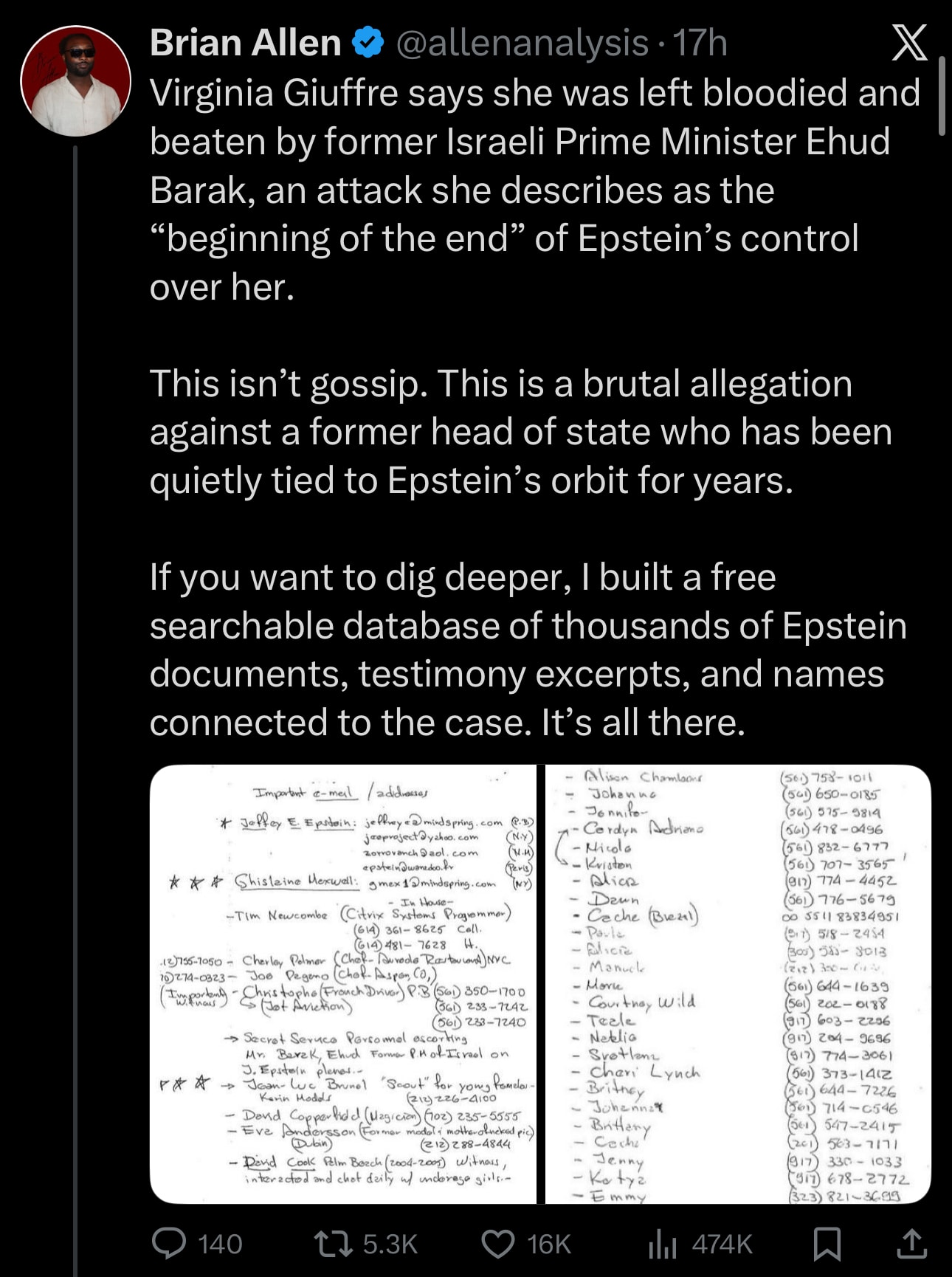
For years, the public conversation around Epstein has been softened into “associations” and “friendships.” Giuffre’s account rips that veneer off. If it’s true, we’re not just talking about men who showed up on a flight log once. We’re talking about powerful political figures allegedly participating in violence against a trafficked minor.
That’s why the searchable database you’ve built, thousands of documents, testimony excerpts, and names tied to the case, matters. It gives regular people the tools to sort rumor from record, see which names keep resurfacing, and follow connections that institutions have zero interest in mapping. If governments won’t build that kind of transparency infrastructure, citizens will.
8. The Senate’s $500,000 Conflict of Interest
The day started with a unanimous 426–0 House vote to repeal a quiet little law that let GOP senators sue the federal government over being “spied on” and then personally collect up to $500,000 in payouts.
Translated: the same politicians who spent years expanding surveillance powers quietly carved out a cash-back clause for themselves, then cried victim when the machinery they built touched their phone records. The House just voted to close the loophole, which now throws the political grenade into the Senate, where the very people set to cash the checks will decide whether to kill their own payout.
It’s a perfect snapshot of how self-dealing works in Washington. Publicly, these lawmakers pose as guardians of civil liberties. Privately, they were lining up a half-million-dollar consolation prize for themselves while the rest of the country got warrantless spying and no check in the mail. The coming Senate vote won’t just be about policy; it will be a roll-call test of who’s willing to walk away from a personal windfall for the sake of basic ethics.
Bottom Line:
Across every clip, the through-line is the same: a political movement testing how far it can push state power, from bullets to border agents, to “just shoot” conversations in the Oval, to death-penalty fantasies for political opponents, while its allies in Congress quietly rig financial and legal side-deals for themselves.
Your feed yesterday didn’t just document the news; it mapped the architecture of creeping authoritarianism and self-protection in real time.